Daring Greatly

Daring Greatly by Brené Brown is about vulnerability and connection. To be able to create a genuine connection with other people you need to show your true self. You need to dare to be vulnerable. It might feel safe to put up an armor and hide behind it, but it also means that you isolate yourself behind the shield that you put up. When we can’t connect to others we suffer. The safety we perceive behind our shield is a farce. It hurts us more than that it protects us.

When someone shares their fears it resonates, because we recognize them. We all feel similar fears and seeing them in others is comforting. It shows us that we are not alone.
But while we find other people’s vulnerability attractive and relatable, we see our own vulnerability as a weakness.

  • Vulnerability is the last thing I want you to see in me, but the first thing I look for in you.
  • Vulnerability is courage in you and inadequacy in me.
  • I’m drawn to your vulnerability but repelled by mine.

The reason we find it so hard to be vulnerable is because we are afraid of shame. Shame is the most primitive human emotions and we all have it (except when you’re a sociopath).
Shame is the fear that something we’ve done or failed to do, an ideal that we’ve not lived up to, or a goal that we’ve not accomplished makes us unworthy of connection. I’m not worthy. I’m not good enough. I’m unlovable. I don’t belong.
Shame is highly correlated with addiction, violence, aggression, depression, eating disorders, and bullying. There are no positive outcomes attached to shame. It’s a destructive emotion.

Shame is the fear of disconnection. It’s something that we attach to ourselves, not to our behavior, making it intensely painful and hard to get out of. We don’t even want to mention shame, and the more convulsive we are about avoiding it, the more power it has over us.
The most effective way to avoid shame is to stay connected. When we feel shame creeping up, instead of putting up our armor we should lower it. We should show our vulnerability despite our fears. That’s what courage looks like.

I feel that being vulnerable and avoiding shame has a lot to do with being authentic. I’ve written here about being bullied as a kid. As a result, I still often feel that people are talking about me behind my back and a fear of shame is never far away. I know intellectually that most people are way too busy with themselves to spend any brain cycles on me, but the fear of being made fun of is deeply embedded in me.

In a sort of weird twist, I’m also unapologetically me. I know what I want and I give absolutely zero fucks about what other people think about that. I prefer to spend an evening on the sofa with a book over going to a party and I’m not afraid to say it out loud. I don’t drink when going out for dinner (especially if the dinner is work-related). And when I travel I always bring a power strip. I’ve been made fun of for that many times. Yet the same people who make fun of it often make use of it.

I’m not afraid of sharing my insecurities and challenges. This is unusual in the IT consultancy world. Yet whenever I do it, especially when presenting in front of larger groups, many people tell me how much they appreciate it.
Despite being comfortable in my own skin I still find myself regularly nodding or uhuh-ing to avoid having to indicate that I don’t understand what was being said, or because I don’t agree but am afraid that my opinion is not a popular one. I try to avoid shame by hiding behind a mask and it never feels right.
The more we are able to be and share our full selves the easier it is to find connection and courage.

We don’t just have to deal with shame in our attempts to be vulnerable and connected. We live in a culture of never enough. As soon as we wake up in the morning we think “I didn’t get enough sleep”. The next thought is “I don’t have enough time”. We spend most of our waking hours hearing, explaining, complaining, or worrying about what we don’t have enough of. Before we even sit up in bed, before our feet touch the floor, we’re already inadequate, behind, lacking something.

This mind-set of scarcity lives at the very heart of our jealousies, our greed, our prejudice, and many of our arguments both with ourselves and with others. It’s hard to be vulnerable and connected when you feel like you are lacking the time and resources to do what you feel you have to do. I challenge you to be honest with yourself the next time you feel like you are being attacked by the scarcity monster. Is there really not enough or are you stressing out and pushing for more out of habit?

Get into the vulnerability arena and put your armor down. Being brave is not winning or losing, it’s showing up. Be authentic. Instead of going for the easy sarcastic snark, try saying something positive when you have a chance. Support others in their attempts to be vulnerable too. Be willing to sit with the discomfort of your own and other people’s vulnerability.
The world can be a much nicer place if we’re all brave enough to show our true selves. Let’s dare greatly.

The image has a red background and shows the title of the book, Animal Farm in black, and the name of the author, George Orwell in grey. The image also shows the profile of a pig in pink with white letters displayed on top of the pig stating "All animals are equal, but some animals are more equal than the others."

Animal Farm

I read Animal Farm by George Orwell in high school, but I must admit I didn’t remember much of it, other than the high-level premise and “all animals are equal, but some animals are more equal than others”. A sentence my father used during my childhood whenever someone tried to apply double standards or argued for doing so.

The original introduction of this book, written by Orwell himself is added to the back of the edition of the book that I read. I found it very interesting to read the introduction, but it was probably a good decision to place this text after the main story. The introduction is almost as long as the entire book and I’m not sure I’d have gotten to the main story had I tried to read the introduction before the rest of the book. This qualification needs a little bit of clarification. The introduction is really long for an introduction to a book, but also, the book itself is very short, it’s only 69 pages. A lot of people probably know this, as it was this characteristic of the book that meant the book got chosen to be on many a high-school reading list.

The main story is about a farm where the animals chase the human owner, who they feel isn’t treating them well, away.
At first, the animals are very happy. They have more autonomy. Even though they still work hard, they feel like they are working for themselves and each other and morale is soaring. All the harvested crops and earnings go to the animals, so they benefit directly from their hard work.
Together the animals draft seven commandments that help the animals to govern themselves and the farm and that provide a framework that they should live by:
1. Whatever goes upon two legs is an enemy.
2. Whatever goes upon four legs, or has wings, is a friend.
3. No animal shall wear clothes.
4. No animal shall sleep in a bed.
5. No animal shall drink alcohol.
6. No animal shall kill any other animal.
7. All animals are equal.

These commandments might sound good and sensible if you’re an animal and they are. Theoretically. Unfortunately, the pigs in the story, like humans in real life, are unable to resist the temptation of power.
After a while, the pigs slowly start to take more power and allow themselves some privileges. They also slowly change the (written) commandments, but they do it by only making one small change at a time and each small change doesn’t seem bad enough to fight.
Eventually, the pigs end up being mean, hypocrite and lying dictators, living a comfortable life, while they work the other animals to death.

Orwell wrote the book in 1943 and it was published in 1945. The story reflects the events leading up to the Russian Revolution of 1917 and the Stalinist era in the Soviet Union following that. If anyone wasn’t able to recognize the story Orwell helps a bit by letting the animals address each other as “comrades”.

Even though the story was written a long time ago, it’s still relevant today, and not just in Russia. The small steps that are taken to break down democracy and that don’t appear to be worth protesting about are visible in many countries around the world. Trump has already gone through many small steps in the US. In Australia Scott Morrison’s government had journalists’ houses raided to try and find the source of an article they felt shouldn’t have been published. In the UK Boris Johnson wants to put the BBC up for sale.
Communism doesn’t have a patent on slowly destroying democracy in favor of a power-hungry dictator.

I hope we won’t let history repeat itself, but I’m afraid that we will. Decent people are just too…decent. And perhaps too scared and too comfortable. We might not start fighting back until it’s too late.
These power-hungry thugs don’t play by the rules. They break as many of them as they can and then change them to suit their needs.

I’m not any better than anyone else. I will avoid conflict if I can and lay low instead of stepping into the ring to stand up to thugs and bullies until I get angry and emotional.
This isn’t easy, but let’s try and stop the thugs before they take over the world.

A snippet of the cover of the book Mindset, by Dr. Carol S. Dweck. Showing the title, the author's name and the subtitle "Changing the way you think to fulfil your potential".

Mindset

I started reading Mindset by Carol Dweck fully convinced that I had a growth mindset. She shattered my conviction in the first few pages of the book. There indeed things for which I feel that putting in the effort will allow both myself and others to get better. It turns out that there are also many things for which I have a fixed mindset and In those areas, I believe that I lack an innate talent required to ever be any good at it.

An example of something I have (Had? Not yet, but I’m working on it.) a fixed mindset about is being able to play music. I’ve tried to learn to play the guitar in my teens and I was never any good at it. I had lessons and practiced, but never with a solid expectation that I would get good. I was always insecure because I saw others who were much better. I was a lighting engineer at the time and compared myself to the people I saw play on the stage. I stopped playing after a couple of years and didn’t touch another instrument until I was tempted into trying to learn to play the piano a year ago.

A fixed mindset means that you believe that your qualities and those of others are carved in stone. That you have a certain amount of talent and that you’ll have to make do with that.
With a growth mindset, you believe that you can cultivate and improve your qualities through effort, practice, and help from others. This doesn’t mean you believe that anyone can become Einstein or Van Gogh or Tim Minchin. It means that you believe that you can improve compared to your own starting point. How far you can improve depends on many factors and in some cases talent is one of them.

It turns out that your mindset has a profound impact on the way you lead your life. If you have a fixed mindset it’s hard to try something new. After all, if you fail it means you’re no good at it and might as well give up straight away. Asking for help is hard because it means admitting to failure and deficiency.
A growth mindset can develop a passion for learning. Trying something new can be seen as a challenge and failing is a chance to learn and improve. Instead of hiding deficiencies, someone with a growth mindset will focus on overcoming them.
It’s easy to see how having a different mindset can significantly change the way you live your life.

Like almost everything else, our mindsets can also be changed and developed. This can be worked on from the inside but is also influenced by external sources. The most direct way to influence someone’s mindset is through praise and criticism.
Dweck explains that praise should be given for effort, trying different strategies and asking for help when needed, not for result (or speed). If you praise a kid because it read a book or got a good mark in school by telling it how smart it is you are suggesting that it’s an innate quality that allowed it to succeed. The kid might feel there’s no need to learn anymore because it’s already smart. If next time the mark ends up being much lower it might feel like a failure.

Be aware that it’s damaging to praise a kid for effort when the kid didn’t actually try hard or ask for help. If a kid fails because it didn’t put in enough effort it should be told so. In a kind and empathic way. A lazy, confused or insecure kid isn’t going to suddenly be motivated when it’s being belittled or threatened.
I’m using kids as an example because it’s easier to associate ideas and behavior around praise and learning with them, but it works exactly the same for us as adults.

In an experiment, two groups of people were being given a puzzle to resolve. One of the groups was given fixed mindset praise when completing it, the other group was being praised for the effort that they put in and the strategy that they used. When asked if they liked the next puzzle to be more difficult or similar to the first one, the group given fixed mindset praise overwhelmingly chose one that was similar to the first puzzle. Resolving the puzzle means you’re smart and failing to resolve a more difficult one might expose you as the fraud that you are.
The group that was praised for their effort was interested in the challenge of a more difficult puzzle.
This effect is visible regardless of the type of mindset that people had before the experiment started.

The impact of fixed mindset feedback is similar. When missing a shot while playing tennis you can get annoyed and tell yourself that you’re hopeless, or you can challenge yourself to stay loose on your feet and try and hit the next one better.
We don’t even need others to talk us out of a growth mindset and into a fixed one. Most of us are perfectly capable of doing it to ourselves. Having others confirm our fixed mindset will make it much harder to find a way out towards a growth mindset though.
If you want to get better at something try to find the motivation to put in time and effort and ask for help. Being brave enough to do this means we can grow in almost every area of our lives.

Carol Dweck is very open about coming to the insights she describes in Mindset through her research. She repeatedly talks about how she struggles to stay in a growth mindset herself in different areas of her life, despite having witnessed the evidence of the benefits first-hand. This is both a refreshing position for an author to take in their own book and it’s reassuring that even someone who wrote a book on the subject is still struggling to put the ideas into practice.
I feel that anyone can learn from this book. When read with an open mind it’s a strong dose of motivation and inspiration. Use it to your advantage.

I was inspired by this book. I have to admit that I feel inspired by many books and I’m not going to apologize for it. Reading books is a great way to grow and learn for me. While I struggle to get out of my fixed mindset when it comes to making music and art, I do have a growth mindset when it comes to improving my behavior and increasing my intellect.

You’ll have to excuse me now. I’m going to practice my piano playing!

An images showing two heads in profile. A blue one on the left has Growth Mindset and characteristics of it written in it. A grey one on the right has Fixed Mindset and some of its characteristics written in it.

The cover of the book #GIRLBOSS by Sophia Amoruso

#Girlboss – Advice about Life with a Touch of Rebellion

I’d never heard of Sophia Amoruso. That might be because I’ve been hiding under a rock, or it might be because I’m not the target audience of her successful webshop, Nasty Gal. I’m also not the target audience for her book, #Girlboss (hashtag included). The target audience of the book is young women (perhaps up to 30?) and girls. The target audience of the webshop is described on the site itself: “WE EXIST FOR THE “GIRL IN PROGRESS”. BADASS TO THE CORE, EVER-EVOLVING AND GROWING, STRIVING TO BE BETTER EVERY. DAMN. DAY. FLAWS ENCOURAGED.”. Caps included. I love growing and evolving, but I’ve always lacked in the badass department.

The book is about Sophia’s own journey from being completely broke and starting a little eBay shop selling vintage clothes to owning and running the multi-million dollar business that Nasty Gal is today. The book is filled with tips for girls who would like to start a company and become a “girlboss” too, but it also includes many tips on how to handle some of life’s challenges in general.
The book is a funny mix of stories about rebellion and an anti-establishment attitude and sensible and quite conservative advice.

In the book’s introduction, Sophia tells her readers to never grow up and to not become a bore. I failed miserably there and I wouldn’t change it for the world. Shortly after that inflammatory advice, Sophia explrds that are really credit cards and how forgetting about them can easily ruin your credit score, even if you only bought something small and cheap on them. She warns that you shouldn’t spend money that you don’t have. Nowadays this advice might not be uncontentious, but it’s very sensible!

Some of the advice and insights that speak to me (and admittedly make me feel righteous), as a manager of young people includes:

  • If you get to talk to customers on behalf of your company, you are the face of the company. Make sure you are polite and that you apologize on behalf of the company if something went wrong, even if it wasn’t your fault.
  • Compromise is a part of life
  • Promotions at work are earned by doing really good (and perhaps not always fun) work for years. They are earned by standing out and taking responsibility.

You could argue that she’s a hypocrite for moving between an anti-establishment attitude and promoting capitalism in the space of only a few pages. It made me smile though. Imagine going from having no responsibilities, all the time in the world and no money or worldly possessions to being a successful businesswoman, running a company that employs thousands of people and having a Porsche car and millions in the bank in only a few years. Part of her brain might still be trying to catch up with her current role and life. Throughout most of the book, this results in a fun and refreshing sort of quirkiness, that might be exactly what young girls who are looking for some inspiration can relate to.

Although the book clearly wasn’t written for me, I did find it inspiring. It gave me a little kick in the behind during the holidays to get up and do something useful with my time off (other than reading lots of books, which I do also think is useful) and it made me determined to get to the bottom of some work-related topics that I was still a bit mystified by.
The advice to not always take everything so seriously and see small challenges as a game does apply to me. It’s been given to me before and I still have no clue how to implement it. There’s always more to learn. It’s what makes me feel energized and alive.

I’ll finish this post with a statement from the book that I can fully get behind:
“Being mean won’t make you cool, being rich won’t make you cool, and having the right clothes won’t make you cool. It’s cool to be kind. It’s cool to be weird. It’s cool to be honest and to be secure with yourself. Cool is the girl at a party who strikes up a conversation with you when she notices you don’t seem to know many people there.”

Sand Talk

The first book I’ve read in 2020 is Sand Talk by Tyson Yunkaporta. Tyson is an Aboriginal person from Australia and in this book he tries to show the reader what today’s world looks like through the eyes of an Indigenous person. Tyson’s background is probably as far removed from mine as it can be.
The fact that I don’t know much about Aboriginal culture means that I lack quite a bit of basic knowledge that would have helped to place some parts of the book into context. At several points in the book, I have to work hard to keep up with the pictures that are painted (sometimes literally) and the explanations that are given. Tyson empathizes with his readers. Stating he gets frustrated when elders seem to mix mind-blowing insights with random, illogical ideas. Wildly new ideas don’t just blow a mind though, they also expand it.

Learning
Expanding your mind, or learning is fun. When new neural pathways are created our brain rewards us with a chemical burst that makes us feel good. Often when people are learning they are smiling.
Today, many people are also afraid of learning. They feel insecure and prefer to have their existing ideas echoed back at them rather than learning about other people’s experiences and points of view. Seeing as learning makes us feel good, we shouldn’t fear to learn about new ideas, we should be actively looking for them! Learning about new ideas doesn’t necessarily mean you have to change your mind. You might still feel that your idea is better than the new idea, but at least try to temporarily suspend your confirmation bias to listen to and learn from others.

Stolen generation
Tyson is part of the stolen generation. In the 1920s the Australian government felt that it would be a good idea to take Aboriginal kids away from their parents and put them in white foster families. Even typing it almost makes me cry. People can be so needlessly cruel, even to innocent kids. Don’t make the mistake of thinking that it doesn’t happen today, as separating refugee kids from their parents at the border isn’t any better. And in The Netherlands, the government likes to send kids who have been here all or almost all of their lives “back to where they came from”. Which is a country they don’t know anything about and where they don’t speak the language. Aaargh!
Right, sorry, I was talking about the book.

Patterns and systems
Indigenous Australian cultures think in patterns, rather than in individual and concrete events, words and objects. They feel that we shouldn’t look at individual elements of a system, but that we should always look at the system as a whole. For instance, the terrible fires in Australia and the floods are in Indonesia shouldn’t be looked at as separate, standalone situations. They are both parts of the same system, they are connected. To resolve them we need to look at the whole system. We need to work with the land and our environment, rather than against it. We’ve been trying to force it into submission for a long time, but it’s starting to hit back at us. It’s time for us to adapt and to find a more sustainable way to interact with our planet. This means that many of us will have to adjust our way of thinking and our way of living. That’s going to be hard and disruptive, but fires and flooding are even harder and more disruptive.

Narcissism
We also need to work together as people, instead of against each other. Even within our own tribes, we are constantly comparing ourselves to others. This is bad for our mental health, but it also stops us from working together effectively. Aboriginal culture assumes that everybody has a bit of idiot in them from time to time. A part of you that whispers that you are special and better and more important than other people. Some people feel like this all or most of the time. Fighting this narcissism is hard and the internet and social media make it even harder. According to Tyson, the excesses of malignant narcissism need to be contained in a team effort, by all of society, working together.

Leadership
Aboriginal wisdom asserts that sustainable leadership consists of four steps: Respect, Connect, Reflect and Direct. Notice that too often we get this completely backward. Not just as individuals, but also as organizations and governments. We start with the assumption that we know better and try to Direct people, communities, or even our kids to do what we want how we want it. When that fails we might Reflect on why it’s not working (in the most positive scenario, there are plenty of examples where we just direct some more, but let’s assume we learn). We gather data and measure outcomes and figure out that we need to hear from the people we are trying to direct. We try to form relationships and Connect with those we want to tell what to do or how to behave. Through these relationships we discover the final step (which should have been the first), we find a profound Respect for those we originally felt were just pawns that we had to get to execute or support our brilliantly (in isolation) crafted plans.
Needless to say, you’re much likely to build support and sustainable relationships if you turn the steps around and start by respecting people and trying to connect with them.

The book is a very interesting read. I can relate to many of the ideas that Tyson shares in it. I’m not sure if it will be possible to get people’s mindset changed to embrace the idea of living in harmony with the land. How most of us think and live today is so radically different the change is even hard to imagine, let alone execute. This isn’t to say that I don’t think it would be a good idea. I’m just not sure if it’s possible. Where would you start if everything had to change? Colonists have tried to force their ideas and way of living onto the Indigenous people of Australia. They have been trying for a long time now and used a lot of violence and while they have significantly damaged Aboriginal lives and heritage, I don’t think they’ve managed to change Aboriginal culture. I’m not convinced it’s possible to do so the other way around either.

I tried to share some of the ideas that Tyson lays out in the book. I had to use my own words and sentences, which means that it has a completely different vibe than the book does. By doing this I did exactly what the book describes we shouldn’t be doing: I picked individual ideas and expanded on them, rather than looking at the whole system at once and look for patterns.
If you feel that the ideas are interesting then please go and read the book, so you Tyson can explain them properly and you can get a better sense of where the ideas are coming from.

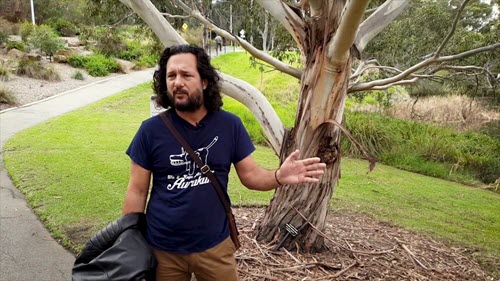
Tyson Yunkaporta