Category Archives: Non-fiction

Inspired by non-fiction

Why I’m No Longer Talking to White People About Race

The more I learn about racism, the more I realize how hard it is to argue against racist ideas. It’s not hard to oppose them, but it’s hard to say something that will get the other person to at least stop and think, let alone change their mind. This week I read Reni Eddo-Lodge’s Why I’m No Longer Talking to White People About Race. A lot of the ideas below were triggered by the excellent explanations and sometimes painful truths in the book.

I try to find a balance between consuming new ideas and staying informed and getting depressed from seeing too much hatred and ignorance online. It’s a thin line to walk on and I often get it wrong. Some of the discourse online scares the hell out of me. A good example is an article on a Dutch news site about the unmarked order troops in Portland who pick up protestors from the streets without identifying themselves and take them away in unmarked rental vans. The comments below that article are filled with remarks that what these troops are doing is justified and that the BLM protests and “Antifa” pose a serious threat to these cities and communities. After all, Trump declared that Antifa is a terrorist organization.

Antifa stands for anti-fascist. A definition of fascism is “a political philosophy, movement, or regime that exalts nation and often race above the individual and that stands for a centralized autocratic government headed by a dictatorial leader, severe economic and social regimentation, and forcible suppression of opposition”. The word was originally used for Mussolini’s party and has since been generalized to include those with similar believes. Against that background and definition, I consider myself to be Antifa. I hope and even assume that most people commenting on the article would not identify as fascists even if some might not identify as explicitly anti-fascist.

Moving away from this specific example, how do you explain to someone who feels picking up BLM protestors of the street is good and just that black people have to deal with systemic and unjust racism and that they are right to demand structural changes? I don’t think many people who aren’t sympathetic towards the BLM organization and protests are afraid of losing their white privilege at this point. I think in many cases they are just scared of change in general. They want things to go back to “normal”. Where normal means that everyone accepts the world that we have today, inequalities and injustices and all. I think. Maybe?

The push for quiet and complacency isn’t new. In 1963 Liberation Magazine published an article by Martin Luther King, Jr that included the following statement: ‘First, I must confess that over the last few years I have been gravely disappointed with the white moderate. I have almost reached the regrettable conclusion that the Negro’s great stumbling block in the stride toward freedom is not the White Citizen’s Counciler or the Ku Klux Klanner, but the white moderate who is more devoted to “order” than to justice; who prefers a negative peace which is the absence of tension to a positive peace which is the presence of justice; who constantly says “I agree with you in the goal you seek, but I can’t agree with your methods of direct action”; who paternalistically feels he can set the timetable for another man’s freedom; who lives by the myth of time and who constantly advises the Negro to wait until a “more convenient season.” ‘Shallow understanding from people of goodwill is more frustrating than absolute misunderstanding from people of ill will. Lukewarm acceptance is much more bewildering than outright rejection.’
I’m ashamed to say that I don’t think we’ve made much progress in this area since 1963. That’s 57 years and two generations! Can you blame black people for getting frustrated with a society, government, and white people from both the left and the right not caring enough to make some real changes?

Part of the challenge of making society less racist is that the changes can’t be made by black people. Racism is about power. It’s about being a position to negatively impact other people’s lives. Lasting changes will have to be made by those in power. Unfortunately, those at the top also benefit the most from the current racist, misogynist power structures and thus have the most to lose. They will only change things when they are forced to. In places where quotas about the number or percentage of women that are being hired or women that are part of boards and leadership teams are enforced the number of (white) women is increasing.
Going forward we don’t just need quota on the number of women, we also need quota on the number of black people that are being hired and that are being promoted into leadership positions.

Many oppose quotas, stating that “the best person for the job” should be hired. But if you think that the homogeneous flock of middle-aged white men currently clogging the upper echelons of most professions got there purely through talent and hard work you’re fooling yourself. We don’t live in a meritocracy, and to pretend that simple hard work will allow people of all skin colors, genders, religions, etc. to achieve the same level of success is an exercise in willful ignorance.

To change racist laws and regulations we need a different approach as no institution can force a government to make changes. Keeping the status quo needs to lead to a structural loss of power or money to enforce changes. This could be achieved if the protests last long enough and through means like the broadly supported bus strike in Montgomery, Alabama between 1955 and 1956. It can also be achieved if those demanding change get so much support that not meeting demands means losing elections.

Even if you’re not keen on protesting you can contribute to the push for a more just world from the comfort of your own home. Especially if you are white. You can help spread the call for change to racist laws and institutions on social media, through letters to newspapers and among your friends and family. People who are not racist, but even people who are anti-racist are often moderate and polite about the issue.
The far-right don’t hold themselves to the same standards. They use bold claims, fear-mongering, and often lies. They use all the platforms they have access to, regardless of whether that’s a “decent” thing to do. They reach a lot of people with these tactics and speak to fear, which is a powerful tool. Their sympathizers don’t nod passionately at their screen when they read these lies, they amplify these right-wing voices in all the ways they have available to them. And they don’t fight among themselves even if they might not agree on all the nitty-gritty right-wing details.

We need to do the same. We need to share our passion for equality and anti-racism with the world. It’s uncomfortable and it might mean we end up in the occasional online shitstorm, but agreeing quietly at home isn’t helpful at this point. To weather the shit storms and limit the number of storms we need to also form a left-wing, anti-racist front. We are too happy to shout at people whose opinion is slightly different from ours while we avoid engaging with people who have a wildly different opinion. Let’s suspend our internal disagreements. They are, frankly, not relevant at the moment. We have bigger fish to fry.

Let’s agree to work together for now and amplify the voices of minorities. The mess we are living in was created by people, it can be dismantled by people, and it can be rebuilt in a way that serves all, rather than a small hoarding few. It won’t be easy but we have to keep working at it. And just as important: we have to continue to believe that we can achieve real change. Because if we lose hope they win and we’re f*cked.


How to be an Antiracist

Yes, it’s another one about racism. We’re not done learning yet. We probably never will be. And you don’t get to complain about having to deal with racism until you’ve had to endure it for dozens of years as black people have.

Besides continuing to learn about racism, I’ve also learned something about books about racism this week. Literally for every book about racism that I’ve read or am considering to read I’ve seen people in my social media timelines explaining why the book is no good, doesn’t explain the issue correctly, or even corrupts the debate. I’ve also seen significant praise about all these books. At first, I felt discouraged by this and wondered what the point is, but after contemplating how to find the “right” books I’ve decided that as long as you’re not just reading one book and keep thinking critically, you’re probably going to be ok. Reading different perspectives can help you to shape your ideas. Those ideas can and should then be adjusted as you absorb more information.

The main insight that I got from Ibram X. Kendi’s How to be an Antiracists is that there are different kinds of racism. When you read about it, it makes sense. But I’d never thought about racism as anything other than just a single concept. The easiest to define and understand types of racism are:

  • Biological racism – the ideas that there are genetic racial differences and that these differences create a hierarchy. If you want that properly debunked I can also recommend reading Adam Rutherford’s How to Argue with a Racist. Even if that book doesn’t really explain how to argue with a racist unless they are using pure biological racism, which I think is rare.
  • Bodily racism – portraying and treating black bodies as more animal-like and violent than others
  • Cultural racism – creating and imposing a cultural standard and imposing a cultural hierarchy. A proponent of this is suggesting that black people will be better off if only they adopt white culture. We consider white customs the norm and anyone with different customs slightly or not so slightly barbaric.
  • Behavioral racism – is about making individuals responsible for the perceived behavior of racial groups and projecting the behavior of individuals onto entire groups.

Antiracism is to actively work against racism and racist ideas. This can start with simple things (theoretically simple at least). Behavioral racism is probably the type of racism we are all guilty of most often. When a white boy isn’t paying attention in school and getting back grades the boy is considered a bad student. Probably undermotivated and undisciplined. When a black boy is getting back grades and isn’t paying attention in school the behavior of the boy is extrapolated to all other black boys. Black boys aren’t worse students than white boys. But we do often feel that the bad behavior of one of them confirms our ideas about the behavior of the entire group. The fact that many white people believe this is problematic, but what’s worse is that these boys internalize those ideas too. And it’s been proven many times that if you believe that you are not as smart as the people around you, your results will suffer because of it.
Ibram Kendi writes that he grew up having many racist ideas himself and that he was sabotaging himself and his future opportunities because of them. He felt that if he messed up he was failing all black people. Can you imagine a white kid feeling like they failed all white people when they do something wrong?

We also extrapolate the positive achievements of individuals to the groups we identify them with, as many immigrant professional athletes can attest to. If they win, they are seen as an integrated part of the country they represent. If they lose they are referred to by their original nationality. This isn’t just true for black people. As a tennis fan, I know that Andy Murray has commented multiple times on the fact that he is called British by the British media when he’s won and Scottish when he’s lost. Of course, his achievements are his and not related to his country of birth or residency.
The same is true for black athletes. Usain Bolt is the fastest man on the 100 and 200 meters because he was a very dedicated athlete, he worked very hard, was very disciplined. He wasn’t an extraordinary athlete because he was black “and black people are better sprinters”. This idea is biological racism. The fact that there are more world-class black sprinters has to do with culture, role models, and motivation. Not with an innate ability to run faster.

Ibram Kendi argues that the source of racist ideas isn’t just ignorance and hate, it’s self-interest. Racist ideas are a by-product of racial policies. Getting rid of the policies is proving to be so hard because the people who have to adjust them have a self-interest in keeping them in place. The people in charge benefit economically and politically from the current system that benefits white people disproportionately.

An example that makes it relatively easy to explain is how schools are funded in the US. Schools are funded by property taxes in the school’s neighborhood. Property taxes are based on the prices of houses and when many black people live in a neighborhood, housing prices plummet. As a result schools in black neighborhoods are underfunded. This could be resolved by designing a different system by which to fund schools. But the people in charge are mostly white. Their kids live in white neighborhoods and go to white schools. Implementing a system that would allow for better funding of schools in black neighborhoods would mean that there will be less money for schools in white neighborhoods. The self-interest of the people in power ensures that the school funding system will not change anytime soon.
This video explains the school funding system very nicely

School funding is just one example. For most racist policies you’ll find similar self-interests keep them from being overturned. This means that the most effective way of protesting is to make it in the self-interest of those in power to change the policies. That’s very hard to achieve and can’t just come from black people. This fight gains more weight when both black and white people in power stand up against racist policies. But these people also have the most to lose. Will enough people be able to accept losing part of their privilege to enhance equality. Remember, when you’re used to privilege, equality feels like oppression. A lot will have to change before we can overturn policies and power structures that support racism today. It will take many self-less people and a lot of time, energy, and courage. I hope we’ll get there and I realize that just reading and writing about racism isn’t enough to contribute in a meaningful way. I also have to examine my privilege and get comfortable with the idea that I will have to give it up to ensure that we all have equal opportunities and resources.

I have been extremely lucky in my life and it’s time to share that luck with as many other people as possible.

White Fragility – Why it’s so Hard for White People to Talk about Racism

As I was working on this post, I realized that I’ve read several books by black authors in the last few months. Unsurprisingly, the number has increased even more in the last three weeks. But even though I’ve read several, I’ve not written about books written by black authors, and the book that I’m talking about today is written by a white woman too. I’ve been thinking about this quite a lot. Why don’t I choose these books to write about? A lot of them are classics, they are great reads and they have taught me about other people’s experiences.

My hypothesis about why I’m not writing about these books is that I don’t feel qualified to comment on black people’s experiences and I’m scared to get it wrong. I’m afraid of being called out for getting it wrong. But not writing about books by black authors is a form of racism too. And not wanting to be called out for having racially problematic ideas is part of my White Fragility and what the book with the same title by Robin DiAngelo is about.

Our society is inherently racist. It’s in our institutions and our unconscious. Because our society is inherently racist, we are all socialized to be racists too. You can’t escape it even if you try. Yet if we’re centrists we feel that the people protecting statues, waving confederate flags, and shouting abuse at black people either online or in real life are racists. When we’re progressives we feel that people saying that all lives matter are racists. Yet if you ask the people in both of these groups if they are racist they will probably say that they aren’t. We see racism as a thing of the past. Slavery was ended a little over 150 years ago and we feel that inequality also ended back then. Being called racist triggers a strong defensive response in all of us. Even Trump claims that he is not a racist.

Most of us find it hard receiving critical feedback regardless of the topic. With racism, this feeling is even stronger. I find it hard to receive critical feedback of any kind and I would be mortified if I were called out about having said or done something that’s racially problematic. We have learned that racists are bad people. This means that we feel that a good person can’t be a racist. And surely we’re good people?! When someone informs us that something we said or did was racially problematic we get defensive, angry, or upset. We often retreat into silence and we feel anxious.
By thinking that all racists are bad people, we’re creating a false dichotomy. For most white people, racism is like murder: the concept exists, but someone has to commit it for it to happen. This limited view of such a multilayered syndrome cultivates the sinister nature of racism and by making it impossible to talk about it, it perpetuates racist phenomena rather than eradicates them. Racism isn’t black and white. Even if we’re good people with good intentions we might say or do things that hurt black people or people of color. Even black people or people of color themselves might have internalized racist ideas because that is what society has taught them.

We must get used to the idea that we all have been socialized to be various levels of racist. Not seeing the color of someone’s skin and not wanting to talk about racism also means we can’t recognize the inequality in our society.
Robin DiAngelo is a diversity coach. She works with groups of people (mostly at the request of the companies they work for) to talk about diversity, racism, and equality. In the book, she explains that as long as she’s talking about racism in a general and abstract sense, white people might get uncomfortable, but they can bear it. However, as soon as it’s pointed out to them that something that they said or did was problematic, the anger comes. There might be tears. People might walk out of the training or retreat into themselves. I can understand that response. But I can also see why that’s not a helpful reaction. If we would be able to receive feedback on our problematic racial patterns we could use it to learn and grow.

Because we have been socialized in a racism-based society, we have a racist worldview and deep racial bias. There’s no point feeling guilty about this. We didn’t choose to live in this society or for society to be based on these racist ideas. We had no way of avoiding our biases. This doesn’t alleviate us from the responsibility to work to unlearn our behaviors. We should try to identify our internalized feelings of superiority and how they are manifesting themselves. We have to be willing to get racially uncomfortable and be willing to examine the effects of our racial engagement. This includes not indulging in the anger, defensiveness, or self-pity that is often our knee-jerk reaction to a racially uncomfortable situation.
Let’s get away from the idea that there’s a good/bad binary when it comes to racism. Let’s accept that we all have a racial bias instead of seeing this claim as a deep moral blow, and let’s work to disrupt it.

I think all white people should read White Fragility.

The Demon-Haunted World

In The Demon-Haunted World, Carl Sagan explains how science works and why skepticism and critical thinking are important. The book is probably more relevant today than it was when it was published in 1995. With the internet at the center of many of our lives and social media allowing everyone to publish and share information, it is critical that we are able to evaluate what we see, hear, and read.

With a lot of non-fiction books, I feel that they are longer than necessary. After about 70% it often feels like the author repeats themselves or like there are too many examples to illustrate a concept.
The Demon-Haunted World is the opposite. It starts a bit slow for me. That’s not surprising as the book aims to explain science and critical thinking for someone with no prior knowledge of either.

The subjects that Sagan touches on are very broad. He details the injustices of the witch trials and talks about people who think they have been abducted by aliens. The parallels that can be drawn between them are interesting.
There are also people, especially in the US, who believe that aliens live among us and that the government knows this but is covering it up. Perhaps that explains a thing or two about the “situation” in the White House today. On the other hand, if there are aliens who are smart enough to travel through galaxies I don’t see how they would let Trump happen. Or, if they couldn’t stop it I assume they have buggered off to their own worlds again. Who would stay for this car crash if they didn’t have to?

Most people who claim to remember things that didn’t happen are genuine. They believe that they were kidnapped by aliens. This is not as crazy as it sounds. Our memories are incredibly unreliable. It’s easy to make someone “remember” something that never happened. A remarkable example is the fact that Reagan during his presidency regularly told stories from his past that turned out to be scenes from films that made a strong impression on him. It’s also quite common to remember a memory from someone close to you as your own. Our minds are fascinating but unreliable.

To support our fallible brains Sagan has included a “baloney detection kit” in the book. Here is my top 5 from the kit:

  1. Look for independent confirmation of the “facts”
  2. Arguments from authority don’t carry more weight than other arguments. Arguments from experts do carry more weight but are still open to scrutiny
  3. Try not to get overly attached to your own hypothesis or opinion. Keep an open mind for new and better ideas and hypothesis (but if you open your mind too much your brain might fall out)
  4. If there’s a chain of argument, every link in the chain needs to hold up to scrutiny, not just some of them
  5. Ockham’s razor: if two hypotheses explain the data equally well choose the simplest one that introduces the least amount of new assumptions

What I like about Sagan and this book is his focus on how to communicate. By “waxing superior and contemptuous” about skepticism and science you are unlikely to convince anyone. Skepticism can come across as arrogant and heartless and it doesn’t have to be either.
We all cherish our beliefs and when someone challenges them this can feel like a personal assault. Whether your beliefs are related to aliens, witches, religion, or science doesn’t matter. Sagan asks “to temper our criticism with kindness”. To apply finesse when we share our believes and opinions. We all have different backgrounds, which means that we come to these discussions with different toolkits and baselines.

The way Sagan talks about curiosity, kindness, and communication inspires me. It makes me excited about communicating complex things in simple terms. About making people feel safe but also interested in learning and gaining knowledge.
I’m not a scientist myself. I don’t naturally ask a lot of questions. Even in a fairly simple conversation, I have to remind myself to ask questions. I’m not sure why. Part of it has to do with the need to process new information before I feel comfortable enough to voice my opinion about it. Maybe another reason is that for several years while in school the safest option was to be invisible and not draw attention to myself.

The Demon-Haunted world makes me want to be more naturally curious, but it mostly makes me long to be a writer or a journalist. I would love to try and share science, skepticism, and critical thinking in a way that allows people with all sorts of different believes to open their minds a little bit. I might figure out how and where to do this eventually. Until then I encourage you to read The Demon-Haunted World. There is something in it for everyone and Carl Sagan made communicating about science an art form.

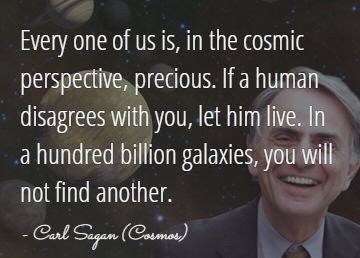
Every one of us is, in a cosmic perspective, precious.

Daring Greatly

Daring Greatly by Brené Brown is about vulnerability and connection. To be able to create a genuine connection with other people you need to show your true self. You need to dare to be vulnerable. It might feel safe to put up an armor and hide behind it, but it also means that you isolate yourself behind the shield that you put up. When we can’t connect to others we suffer. The safety we perceive behind our shield is a farce. It hurts us more than that it protects us.

When someone shares their fears it resonates, because we recognize them. We all feel similar fears and seeing them in others is comforting. It shows us that we are not alone.
But while we find other people’s vulnerability attractive and relatable, we see our own vulnerability as a weakness.

  • Vulnerability is the last thing I want you to see in me, but the first thing I look for in you.
  • Vulnerability is courage in you and inadequacy in me.
  • I’m drawn to your vulnerability but repelled by mine.

The reason we find it so hard to be vulnerable is because we are afraid of shame. Shame is the most primitive human emotions and we all have it (except when you’re a sociopath).
Shame is the fear that something we’ve done or failed to do, an ideal that we’ve not lived up to, or a goal that we’ve not accomplished makes us unworthy of connection. I’m not worthy. I’m not good enough. I’m unlovable. I don’t belong.
Shame is highly correlated with addiction, violence, aggression, depression, eating disorders, and bullying. There are no positive outcomes attached to shame. It’s a destructive emotion.

Shame is the fear of disconnection. It’s something that we attach to ourselves, not to our behavior, making it intensely painful and hard to get out of. We don’t even want to mention shame, and the more convulsive we are about avoiding it, the more power it has over us.
The most effective way to avoid shame is to stay connected. When we feel shame creeping up, instead of putting up our armor we should lower it. We should show our vulnerability despite our fears. That’s what courage looks like.

I feel that being vulnerable and avoiding shame has a lot to do with being authentic. I’ve written here about being bullied as a kid. As a result, I still often feel that people are talking about me behind my back and a fear of shame is never far away. I know intellectually that most people are way too busy with themselves to spend any brain cycles on me, but the fear of being made fun of is deeply embedded in me.

In a sort of weird twist, I’m also unapologetically me. I know what I want and I give absolutely zero fucks about what other people think about that. I prefer to spend an evening on the sofa with a book over going to a party and I’m not afraid to say it out loud. I don’t drink when going out for dinner (especially if the dinner is work-related). And when I travel I always bring a power strip. I’ve been made fun of for that many times. Yet the same people who make fun of it often make use of it.

I’m not afraid of sharing my insecurities and challenges. This is unusual in the IT consultancy world. Yet whenever I do it, especially when presenting in front of larger groups, many people tell me how much they appreciate it.
Despite being comfortable in my own skin I still find myself regularly nodding or uhuh-ing to avoid having to indicate that I don’t understand what was being said, or because I don’t agree but am afraid that my opinion is not a popular one. I try to avoid shame by hiding behind a mask and it never feels right.
The more we are able to be and share our full selves the easier it is to find connection and courage.

We don’t just have to deal with shame in our attempts to be vulnerable and connected. We live in a culture of never enough. As soon as we wake up in the morning we think “I didn’t get enough sleep”. The next thought is “I don’t have enough time”. We spend most of our waking hours hearing, explaining, complaining, or worrying about what we don’t have enough of. Before we even sit up in bed, before our feet touch the floor, we’re already inadequate, behind, lacking something.

This mind-set of scarcity lives at the very heart of our jealousies, our greed, our prejudice, and many of our arguments both with ourselves and with others. It’s hard to be vulnerable and connected when you feel like you are lacking the time and resources to do what you feel you have to do. I challenge you to be honest with yourself the next time you feel like you are being attacked by the scarcity monster. Is there really not enough or are you stressing out and pushing for more out of habit?

Get into the vulnerability arena and put your armor down. Being brave is not winning or losing, it’s showing up. Be authentic. Instead of going for the easy sarcastic snark, try saying something positive when you have a chance. Support others in their attempts to be vulnerable too. Be willing to sit with the discomfort of your own and other people’s vulnerability.
The world can be a much nicer place if we’re all brave enough to show our true selves. Let’s dare greatly.