
Category Archives: Inspiration

On writing – Writing advice from Stephen King

I’m not a Stephen King fan. I saw the film Misery with my classmates when I was a first grader in high school. I tried to hide my fear, but I was so scared I never got close to anything related to Stephen King again after that. Until this book. I figured that a book on writing should be safe enough.

The first 30% of the book is a biography. I don’t know why he decided to structure the book like that, but it works. It provides context for the writing advice and it made me trust him.

When he does talk about writing he explains that he doesn’t believe in plotting a story. This is interesting to me because it’s 100% opposite to the premise of Story Genius by Lisa Cron that I read a few months ago. Stephen’s explanation is that you can’t plot life. Plotting a story is likely to suck the energy out of it. It will become artificial.

The thing I like most about this is that I’m pretty sure I won’t have the patience to plot a story the way Lisa Cron proposes to do it. Stephen King compares a writer discovering a story while writing to an archeologist uncovering a fossil. While it’s still a lot of hard work it sounds like a lot more fun than plotting out every little detail before starting the actual writing.

For King, a story starts with a situation. There is no plot to start with and characters are flat. The characters come to life when the situation starts to develop. While he’s writing and excavating the story from where it’s buried the plot will become visible.

He completes his first draft without sharing any of it with anyone. This helps him to maintain the energy and speed. While writing a first draft, any outside input, whether praise or criticism, could impact the development of the story. Once the first draft is finished a small number of “important readers” get to read it, ask questions about it and give feedback. You should also read your first draft yourself. According to King, this is a very positive thing that you will likely be looking forward to at that point.
I’m not convinced I’d feel that way, but who knows, maybe I would.

I don’t know if I’ll ever write a novel, but if I don’t it won’t have anything to do with On Writing or Stephen King. I’ve gotten to like him through reading this book. I’m not sure if I like him enough to get me over my trauma and try reading one of his other books, but I’m considering it. It won’t be Misery though, that’s for sure!

When asked how do you write

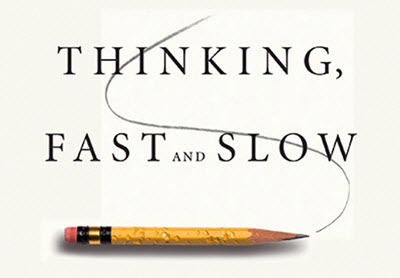
Thinking fast and slow – why it’s good to think about your thinking

Thinking fast and slow by Daniel Kahneman provides many interesting insights. It does take some persistence to get through. According to Kindle, it takes the average reader 11 and a half hours. I tried to read it a couple of years ago, but at that point gave up fairly quickly. Now that I finished it I do think it was worth it.

Our brain consists of two mechanisms that in the book are referred to as systems. System 1 is uncontrolled and often biased, but it’s quick and it doesn’t use a lot of energy. System 2 is deliberate, but also slow and lazy. It leaves as much as possible to system 1, which means that a lot of our initial reactions are uncontrolled and biased. The book contains many examples of how this impacts our ideas, decisions, and impressions. Some of it is so fundamental that it should be taught in schools.

An area in which we should be especially suspicious of our intuition and gut feeling is statistics. It has been proven that even statisticians have a terrible intuition when it comes to statistics.

For instance, we forget that in most events, especially when they are extreme, good or bad luck plays an important role.

  • When a golfer plays exceptionally well on the first day of a tournament, we expect that person to also do exceptionally well on the second day. However, the great score on the first day was exceptional, meaning, an exception. Therefore the score of this player is likely to be closer to average on the second day. Meaning there is a significant chance the player will be worse on the second day than on the first. The opposite happens when someone plays unusually bad on the first day.
  • Suppose you have to interview two candidates for an open position. One of them has a lot of experience, the other has little proven experience. If the first job applicant has a mediocre interview and the second one smashes the interview, we are likely to hire the second person. Even though there’s a significant chance that the great interview of the first applicant is a lucky shot. It is likely that the work of the second applicant over time will be better. We should assume that the long term performances of both candidates will be closer to what would be average based on their experience, rather than to how they came across during the interview.

This mechanism can also fool people into thinking that punishing someone for a bad performance makes them do better next time. When in fact the person was always likely to improve compared to the mishap.

Another example of why we can’t do statistics based on intuition is because when events are easy to retrieve from memory, we tend to overexaggerate how often they occur. Something that’s more flashy and dramatic sticks to memory more easily, even if it doesn’t happen a lot. For instance, far more people die in car crashes or through heart failure or cancer, but it’s a lot easier to remember a terrorist attack.

Not related to statistics, but relevant when talking about biases and in the context of how quickly “us progressives” tend to judge more conservative people is that the human mind is unable to reconstruct past states of knowledge. We forget that we didn’t know before what we now know and we are unable to recall what we used to think or believe.

We think that we are rational beings, but we are a lot less rational than we think we are. How a question or a choice is framed determines the answer many of us will give. When we are asked to weigh wins and losses a loss is weighed twice as high as a win, making us behave irrationally when gambling for instance.

If all of these examples are as fascinating to you as they are to me then I recommend reading “Thinking Fast and Slow”. Even if it does take some patience and tenacity.

Nothing in life is as important as you think it is

By reading the writings of the most interesting minds in history

Writing about Reading

I’m reading a lot at the moment.
The general consensus is, that reading inspires writing. That’s not how it works for me though. It’s like my brain is either in reading or in writing mode and finds it hard to combine the two.

Because I don’t want to give up on reading or writing on here, I figured I might have to challenge my brain.
I will write about the books that I read and how they inspire me. Many of my posts are already based on books, but from now on it’s going to be more explicit. It won’t just be book reviews, but it will be about what I got out of a book. I will try to include as many of the books that I read as I can. Even if that means that some posts will be short.

I hope that this will create a habit that means I’ll be writing more.
The added benefit is that it provides a bit of focus on my writing. At the moment, my topics are pretty much all over the place and my group of readers is small (but loyal and much appreciated!).
Perhaps more regular posts and a bit more focus will help to increase my reader base.

That’s my plan. Now to start writing again.

A successful team

Do we have success backwards?

When we think about a successful person, we often think about someone who is very busy, works very long hours and often weekends. I used to think like this and I used to work all the time because I felt that’s what you’re supposed to do to have a successful career.
If we’re honest though, does living like that sound appealing? Do you want to work all the time? Unable to unwind, because you’re always checking your emails?

Last year, after reading Flow by Mihaly Csikszentmihalyi and Busy: How to thrive in a world of too much by Tony Crabbe, I’ve made changes to the way I work. I’ve turned all email notifications off, on all my devices, including my main laptop. If I want to see my emails I have to consciously open up Outlook. This allows me to concentrate on a task, rather than getting distracted by every incoming email.

Blocking time in my calendar allows me to deal with anything that does need urgent attention (which usually means it’s about people, not things). I’ve also put aside time to work on important projects that are not urgent, to make sure that I’m not just solving today’s crisis every day. These changes have allowed me to cut down the number of hours that I work. Yes, I do occasionally do a bit of work in the evening, or on the weekend, but it’s an exception now, rather than the rule that it used to be. At the same time, I feel like I accomplish more. And my mailbox hasn’t turned into one of these black holes that some of my colleagues seem to be dealing with. Or trying to anyway.

If people see you as a leader there’s another problem with working all the time and not responding to emails. People who work for you will mimic your behavior. They will work all the time and feel that it’s ok to not reply to emails. Because that is the example that you are setting. Even if you tell them they shouldn’t, they will do as you do, not as you say.

After reading Multipliers by Liz Wiseman the idea that working a lot of hours isn’t necessarily a good thing took even stronger root for me. Multipliers are genius makers. They bring out the intelligence in others. They get the most out of their teams and makes them feel trusted and valued. The opposite of a multiplier is a diminisher. Diminishers, who almost always mean well, get less than half of the intelligence and energy out of their teams. They leave their teams underutilized.

Diminishers feel that intelligence is scarce and fixed and that they if they want something to get done, they have to get personally involved. With a mindset like that, you can understand why someone might be very busy.
Multipliers look for what people are naturally good at (their native genius) and try to stretch and grow those skills even further. They create space for others and allow them to fail, within a reasonably save boundary. They do however also demand that people take ownership and they won’t shy away from asking hard questions.

I’ve been trying to act as a multiplier for several months now, but I find it hard to tell how well I’m doing. The accidentally diminishing behavior that I’m most likely to exhibit is called “Pace Setter”. Being a Pace Setter means you are so on top of things, working so quickly, or focused, or at such a high quality that no one else gets a chance to step in and take responsibility. While working for a leader like that might sound ideal, it often means that other people don’t get a chance to use their skills and intelligence. If you do this for too long, they will give up, because you will take care of things anyway.

A clear sign of multiplying is delegating significant amounts of work to your team, in a way that allows them to be successful. I’m working with the best teams that I can possibly wish for and seeing people grow and be successful is the most rewarding part of my job.
The added benefit of delegating is of course that you don’t have to do all the work yourself. Thus allowing you time to work on projects that are challenging you and that allow you to grow too. And to spend your evening writing a blog post.
Today was my first day back at work after a two-week break and I was lucky enough to be part of a brilliantly led meeting that was not only a lot of fun, but that also achieved a result that I did not expect at the start.
If anyone is looking for me I’m over here trying to create more space for my team and being very proud.

A fresh perspective

The value of a fresh perspective

You know that feeling when a single word, or a seemingly insignificant event, makes all the pieces of a puzzle that you have been working on for a while fall into place?

During the annual week-before-Christmas dinner and drinks marathon, after one of the dinners, I was talking to a colleague. He commented on the “people program” that I’m working on. The light bulb that went on above my head could have lit the entire street.

I’ve been working on a dozen initiatives that are aimed at making working for our company even more fun and engaging than it already was for our existing teams. I’ve also been working on trying to communicate how much fun it is to work for us to the outside world.

Until last week I thought about this as a bunch of initiatives. But when my colleague called it “a program” everything fell into place. There was more structure around the things that I’d been working on and it became easier to communicate about it. Seeing it through the lens of a program made it look impressive even to me!

This served as a good reminder that sharing and discussing your ideas with others allows you to improve on them and it can give you new insights. Even if you are an expert on a topic, there is value in discussing your ideas and thoughts with others. Trying to explain what you are working on to someone else sometimes helps you to realize gaps or unclarities. A fresh pair of eyes can help to uncover blind spots and a bit more distance can offer a refreshing perspective.

Reading a lot of books on a topic and studying the results others have achieved will allow you to learn a lot. It can also inspire you. Putting the things you learned into practice will give you real-life experience and feedback. Based on this you can further refine your ideas.

Keeping an open mind and discussing your ideas with others will give you input from different perspectives. Small suggestions can make your plans exponentially better. Or as in my case, allow you to communicate about them in a more impactful way.