Category Archives: Fiction

Inspired by fiction

The Taming of the Shrew

It was another Shakespeare week. This time I read The Taming of the Shrew. Which before this I thought was called the taming of the screw. It didn’t make sense, but I figured that was just my somewhat limited understanding of the English language.

I felt that The Taming of the Shrew was easier to read than Hamlet and Macbeth. That the English used is more modern-day English. That doesn’t make sense, as it is thought that this might be Shakespeare’s first play. If you have read it I love to hear your thoughts.

The story is no more uplifting than the above mentioned two, although no one dies in The Taming of the Shrew. Baptista is a rich man from Padua. He has two daughters, Katharina (or Kate) who is the oldest and Bianca. Katharina is considered a difficult woman. Bianca is much more complacent. Several men are fighting for the right to marry Bianca, but Baptista makes it clear that Bianca will not get married before Katharina does.

Luckily for Bianca’s suitors, Petruchio shows up and he likes Baptista’s money and the challenge of trying to tame Kate. As they meet for the first time Kate slaps Petruchio. While Petruchio never physically touches Kate he creates an extensive scheme of emotional abuse and manipulation. He hits the priest that marries them and abuses his servants, under the pretense of feeling that they didn’t deliver the perfection that Kate deserves, all with Kate present. He won’t let her eat because the meat isn’t good enough. He won’t let her sleep because the bed isn’t good enough and the sheets aren’t clean enough. He starves Kate and keeps her awake at night under the guise of perfect love. He plays mind games on her until she gives up on all her ideas and opinions.

Eventually, he breaks her. Kate will serve Petruchio without ever questioning him. She will always agree with him for fear of what he will do if she doesn’t.
Apparently, there is a discussion about whether The Taming of the Shrew is a passionate love story or an examination of brute male domination. I don’t understand how this can be a discussion. If your partner thinks this is what passionate love looks like I advise you to run fast and far.
I’m happy to have read another Shakespeare play, to be able to tick it off the list, but it’s safe to say that this will not be my favorite.
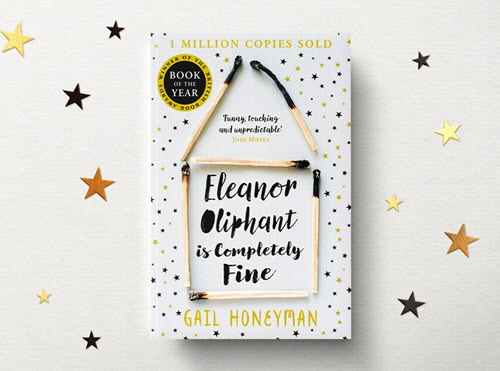
Eleanor Oliphant is Completely Fine – uncomfortable and gripping

I picked Eleanor Oliphant is completely fine because it kept coming up as a suggestion at several booksellers, both online and offline and because I was fascinated by the title. Whenever I saw the title I had images of Babar the Elephant pop into my mind. That’s not surprising as “elephant” in Dutch is “olifant”. For that reason, I also wondered if there was a link with The Netherlands.
I don’t think I’m giving away too much by telling you that the book is not about elephants and that there is no connection with The Netherlands. The book is set in Glasgow.

Eleanor is a thirty-year-old woman and her interactions with other people are a bit awkward. I cringed through the first few chapters of the book. At times it was so uncomfortable I wasn’t sure if I should read on as quickly as possible or if I should put the book away. Every time I opted to read on. I read while cooking, while having dinner and while making tea. I went to bed too late and then read some more in bed. I still find it hard to say what made it so hard to put the book down, but it is clearly brilliant writing from Gail Honeyman. It’s so good that it’s hard to believe this is Gail’s debut novel, but it’s also so fresh and original that it’s easy to believe it’s a debut.

Eleanor is unworldly. In many ways, she’s like an awkward teenager, except she’s thirty and seems to be immune to peer pressure. She reminds me a bit of my early teenage self in its worst moments. That’s not something I want to be reminded about, to be honest, but thankfully that’s where the similarities end.

One of the differences between Eleanor and my teenage self is that Eleanor doesn’t like hard rock and musical theatre. I loved both and hard rock was one of the things that finally helped me to fit in somewhere. To be part of a group. I was on team black t-shirts, black jeans, and army boots. Dressing up for family affairs meant wearing a black dress and army boots. I loved it. It was my way of rebelling.
Musical theatre was very much a family thing for me. The first time I saw a musical in real-life was when the whole family went to see Cats for my grandparents’ 50th anniversary. I was mesmerized. I don’t have high hopes for the film, but I will definitely watch it! Eleanor summarizes her opinion about musical theatre thus: “There is no such thing as Hell, of course, but if there was, then the soundtrack to the screaming, the pitchfork action and the infernal wailing of damned souls would be a looped medley of ‘show tunes’ drawn from the annals of musical theatre. The complete oeuvre of Lloyd Webber and Rice would be performed, without breaks, on a stage inside the fiery pit, and an audience of sinners would be forced to watch – and listen – for eternity.”
It made me laugh out loud.

It’s hard to talk about this book without giving too much away. There are many surprises in there and I don’t want to ruin them for you. I recommend that you read Eleanor Oliphant is Completely Fine yourself. It’s a lovely, surprising and unexpectedly gripping book.

So Long, and Thanks for All the Fish

This book has the nicest and most on point prologue I remember reading. It’s almost worth getting the book just for the prologue.

So long, and thanks for all the fish is the fourth book in the Hitchhiker’s guide to the galaxy series. If you haven’t read the previous three it’s probably a good idea to start at the beginning, as there is some order in the chaos of traveling through the Galaxy. I do feel like the books are getting better with each one that I read, so if you can’t get into it right away it’s worth it to keep going.

Eight years after Arthur Dent was abducted by Vogons, which was seconds before the earth was destroyed to make room for a new hyperspace bypass, he’s back on earth. On earth, only a couple of months seem to have passed and Arthur has decided to slip back into his old life. This is surprisingly easy, as people have extraordinarily short memories.
There is one problem though. Arthur is not the same person he was eight years ago. Eight years of wandering across the Galaxy and experiencing all sorts of craziness alters your brain. Mind you, even ordinary experiences can alter our brains, so Arthur’s experience is hardly surprising.

Science has proven that once you have learned something new you can never go back to the way you were before that. You can’t even remember what it was like to not know this new thing that you learned. This makes it so hard for us normal people to have empathy for those around us who don’t already know what we now know. Arthur’s problem isn’t so much that he doesn’t have empathy, he would just like the Universe to stop doing whatever it’s doing to him.

I love all the funny and quirky references to science and the human condition in the book. You can enjoy the book without even noticing them but for me, they are the witty icing on the cake of a fun story. For example about confirmation bias and the fact that we have to apply critical thinking rigorously.
“He felt a spasm of excitement because he knew instinctively who it was, or at least knew who it was he wanted it to be, and once you know what it is you want to be true, instinct is a very useful device for enabling you to know that it is. ”
We shouldn’t just think critically about what others think and say, but we should also be critical of our own thoughts and intuition. We often see what we want to see and explain situations to fit our pre-existing narrative.

On his travels, Arthur meets a scientist who calls himself Wonko the Sane. He calls himself “the Sane” because so many people think that he’s crazy. He’s smart though and he says “You can’t possibly be a scientist if you mind people thinking that you’re a fool.”.
The world in general and social media more specifically make this even worse. Scientists are being called many names that are much worse than crazy for trying to share their knowledge with the rest of the world.

I admire the scientists who are able and willing to continuously endure this kind of abuse. You must be passionate about science and sharing what you learned to do that.
In a next life, I would like to be a scientist. I didn’t think this through but that’s ok because I don’t believe in a next life. It allows me to dream all I want.
I would find the abuse very hard to deal with, but I would love to work on discovering new things that would make the world a better, prettier, safer or nicer place. This is heavily romanticized, but it feels like it would be a wonderful way to make a difference to the world and the people on it.

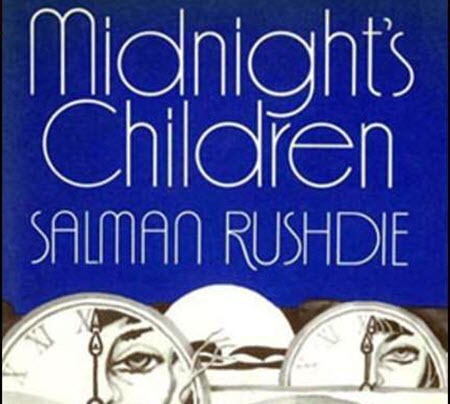
Midnight’s Children – a remarkable story about synchronicity

According to the Man Booker prize judges, Midnight’s Children by Salman Rushdie might be the best book of all times. That’s what made me decide to read it. I don’t feel like I’ve read enough to have an opinion on what might be the best book of all times, but it’s a marvelous story.
The protagonist and narrator of the story is Saleem Sinai, who tells the story of his extraordinary life and how it’s fused to India’s political turmoil. Saleem is born at midnight on August 15, 1947, the exact moment of India’s independence from the United Kingdom. Because of this synchronicity, Saleem’s life is linked to that of the newborn country.

I must (to my shame) admit that I knew close to nothing about the history of India and the rest of the region. This book taught me a lot and also motivated me to read up on it a little bit more. If you have visited the region or are planning to this book is worth a read just for a very entertaining way to get yourself educated a bit. Do note that the book is fiction, so not everything should be taken literally. The book also gives the reader a glimpse at some cultural phenomena. One that I got to experience myself and that comes back many times in the book is eating (and chewing on) paan. It must have been about 5 years ago now and I still can’t read or write about it without my insides making a double backflip. (I know some of the people who were there read the blog and I’m sure they’ll be smiling while reading and remembering it.)

The life-changing events and absurdities in Saleem’s life keep coming and make sure that even though Midnight’s Children is a long read, it never gets boring. There is always a remarkable twist in the story just around the corner. The book is also full of brilliant one-liners and potential internet meme’s.
One that stood out for me is “Most of what matters in our lives takes place in our absence.”. It’s easy to spend a few hours reminiscing about the truth in that.

The book constantly hovers between a retelling of history and wildly imaginative fictional story. A bit like Matt Haig’s How to Stop Time does too. Although it’s about a different time and place. Rushdie (or Saleem) addresses this on several occasions without specifying what is true and what is make-believe.
Saleem says “Reality is a question of perspective; the further you get from the past, the more concrete and plausible it seems – but as you approach the present, it inevitably seems more and more incredible.”. We don’t have to stretch our imagination to strongly feel this statement. I don’t think there are many people who don’t feel that the time in which we live is incredible, for better or for worse. I wonder how people will look back at today in let’s say 100 years’ time. Perhaps there will be a writer that can write a story as imaginative and as delicately linked to history as Rushdie did about the 31 years after India’s independence.

There’s even a statement from Midnight’s Children that might help to explain some of what we see happening today. “Memory’s truth, because memory has its own special kind. It selects, eliminates, alters, exaggerates, minimizes, glorifies and vilifies also; but in the end it creates its own reality, its heterogeneous but usually coherent version of events; and no sane human being ever trusts someone else’s version more than his own.” Who is a sane human and who isn’t remains up for debate of course…

More beautiful sentences and the interesting statements can be found throughout the book, but there is no way for me to weave them into a semi-coherent blog post. If you are curious about them, or about Saleem’s story I propose you just dive into Midnights Children and get fascinated by Rushdie’s beautiful writing and his incredible imagination and storytelling.

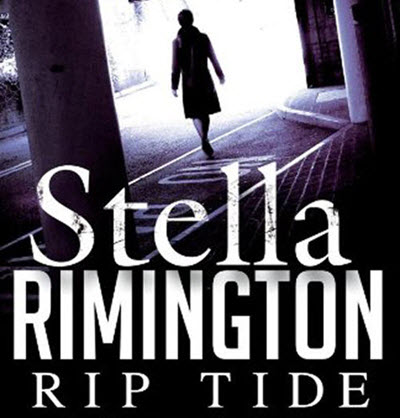
Rip Tide – more to it than meets the eye

After all the seriousness from the last few weeks, I read Rip Tide by Dame Stella Rimington this week. I love the idea of – and reading about – badass women. Both Stella and Liz Carlyle, the protagonist, fall into that category. Stella Rimington was the head of MI5 before she became a writer. I can’t begin to imagine the obstacles she must have faced to become the head of MI5. I’m sure not everyone was happy to see a woman climb the ranks like that. It must have taken a lot of hard work and perseverance to get there. And she must have been very very good at her job.

I have no idea how good Stella really was as an agent and the head of MI5, but I love her writing. She has written what is so far a 10 part series about Liz Carlyle, who is also an MI5 agent. Rip Tide is the 6th book in the series.
Even though the protagonist is a woman, the books are not just for women. After all, women also read books with male protagonists. If we didn’t it would limit our choice of books to read significantly and we would miss out on many beautiful stories.

Liz comes across as a real woman. There is no over the top drama, she’s not worried about the size of her breasts or the way they might be moving (or not). She does sometimes regret wearing heels, or worries about what to wear to not stand out and feel uncomfortable at particular events or places.
I love Liz’s empathy and her concern for other people’s wellbeing and the way in which we see her struggle when her values clash with the responsibilities that are part of her job.

In Rip Tide, a charity’s ship is being attacked by pirates of the coast of Somalia. It’s the third time pirates try to take one of their ships and its crew hostage. Is it a coincidence or is there more to it? One of the pirates is not like the others. He doesn’t communicate with the other pirates. What’s his story?

All the Liz Carlyle novels are enjoyable and exciting from start to finish. They are easy to read and there is enough tension to not want to put the book down, but it’s not so tense that you are afraid of what you’ll discover if you read on.
I highly recommend all Liz Carlyle books, including Rip Tide. For those new to the series, the first book is At Risk.

Stella Rimington

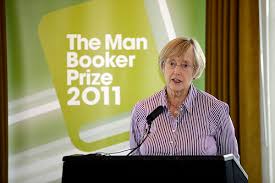
Stella Rimington was the chair of judges of the Man Booker prize in 2011 and her speech describes some of the interesting dynamics around that role.
It’s almost impossible to just pick one snippet from it, so I’ll just share the start. You can find the full speech at the Man Booker Prize web site.

“Well – I thought the intelligence world was the place for intrigue – but that was before I met the publishing world.
Since our shortlist was announced we’ve seen black propaganda, de-stabilisation operations, plots and double agents – worthy of the KGB at its height.”